Something extraordinary is happening on the internet right now, and once you see it, you may not be able to unsee it.

Written by: Rozelinde
A life of learning across people, cultures, systems, and spirituality — mapping the hidden architecture behind how people suffer, connect, lead, compete, heal, and drive cultural change.
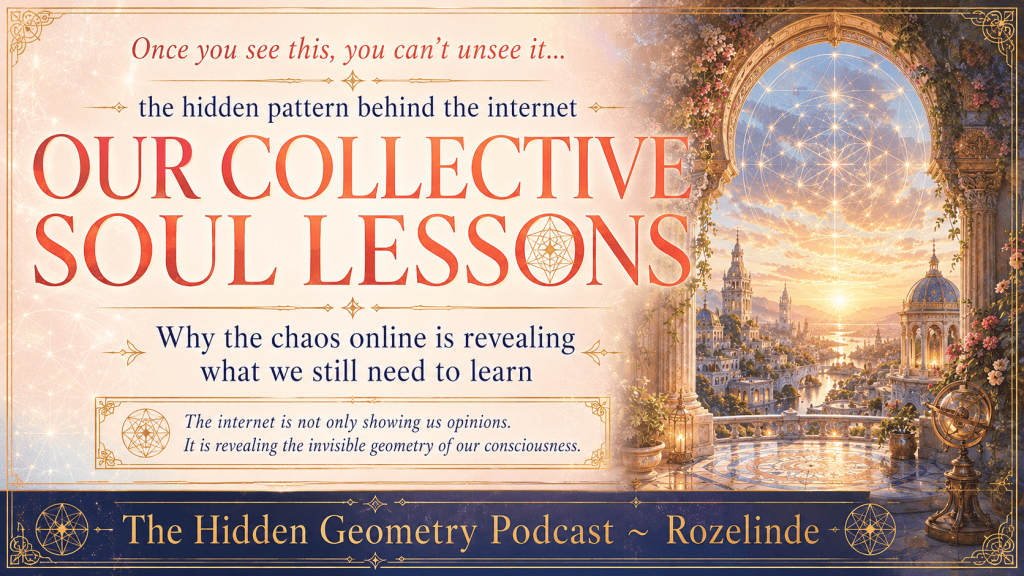
The internet is not only showing us trends, opinions, crises, personalities, products, and endless little fragments of human life. It is revealing something much deeper: the invisible geometry of our collective world — the hidden dynamics, patterns, and blueprints underneath the surface.
It reveals the lessons we are still learning as individuals, communities, and a civilisation. But it also reveals something so much more hopeful: our expansion, strengths, creativity, opportunities, and the new forms of connection and courage that are becoming possible.
And that is not negative news.
It is powerful news. Our feeds are becoming a kind of accidental spiritual mirror.
They are showing us where we are afraid. They are showing us where we are hungry to be seen. They are showing us where we have confused visibility with value, intensity with truth, and being special with being deeply fulfilled. They are showing us the places where we still compete for love, attention, safety, meaning, influence, and belonging.
And this is actually magnificent news, because what becomes visible can become conscious. And what becomes conscious can be healed, transformed, and used to create something much wiser.
In my work, I often speak about the hidden geometry behind things.
Not geometry in the equations-and-homework sense, although mathematics is also quite magical when you really look at it. I mean the invisible structure beneath the surface. The pattern underneath the pattern. The emotional architecture beneath the behaviour. The consciousness beneath the decision.
We often look at life as if we are only seeing separate events. Someone is anxious. Someone is poor. Someone is angry. Someone is successful but exhausted. Someone is fighting online. Someone is desperately trying to become visible. Someone is trying to convince everybody that they are healed, enlightened, unbothered, irresistible, iconic, and apparently never late for a Zoom call.
But beneath these separate moments, there are deeper individual and group-dynamics at work. These are NOT stand-alone situations and causes.
And no, I am not talking about hidden rulers, secret arrangements, underground aliens, or dramatic conspiracy theories. I mean the ordinary, powerful patterns we create together every day.
There are dynamics inside the individual:
These explain for example how fear moves through the nervous system, how a belief becomes a reaction, how old pain becomes a strategy, how a hidden need becomes a loud behaviour.
What I mean by hidden individual geometry is the underlying system through which a person’s inner world is formed and organised. It is the network of influences that gradually creates certain emotional tendencies, beliefs, reactions, habits, strengths, sensitivities, and behavioural patterns.
An experience creates an interpretation. That interpretation can become a belief. A belief shapes expectation. Expectation influences emotional response. Repeated emotional responses create familiar reactions.
This personal constellation is formed through many intersecting influences: ancestry and family patterns, upbringing, culture, environment, friendships, education, painful or formative experiences, the emotional atmosphere around us, our inner imagination, our natural temperament, the hereditary subtleties, our particular gifts, and the deeper soul and energetic qualities we arrive with.
There are social & family dynamics:
This layer looks at how groups and families create belonging, exclusion, status, pressure, admiration, competition, loyalty, shame, imitation, and silence.
And there are global collective system-dynamics:
These are the invisible agreements we create together about what matters, what is rewarded, what is mocked, what is safe to say, who is allowed to shine, and who is expected to stay small.
Oh, and not to forget: there are also soul — or spiritual — dynamics at work.
Spirituality, But Make It Human
I translate spiritual ideas into clear emotional, social, and human language — so we can understand how they shape our lives, relationships, cultures, and systems.
By spiritual and energetic influences, I mean something very practical: the extent to which individuals or groups have learned to relate wisely to the basic realities of life and humanity. Can they live with uncertainty, change, impermanence, vulnerability, and the complexity of relationships? Do they have a stable relationship with themselves, or is there a deep layer of unworthiness, fear, or disconnection underneath?
Why This Is Not Naivety — But Structural Intelligence:
Because the way we relate to life’s natural dynamics, our emotions, our consciousness and the larger whole becomes the basis of both personal wellbeing and collective behaviour across society.
When the soul of a collective is not cared for — when people are not given emotional language, dignity, belonging, meaning, and ways to process fear — instability grows. And unstable people create unstable structures.
Spiritual and energetic influences also affect the individual and wider emotional atmosphere enormously: for example, a deep collective fear around life, safety, connection, or cultural judgment can influence how much warmth, flexibility, trust, and stability a culture is able to create.
These subtle attitudes belong to the soul-spiritual layer, and its influence is enormous: it shapes the atmosphere, values, courage, and direction. We often underestimate how profoundly they shape society.
A society can have excellent technology, policies, and institutions, but when its people are deeply disconnected from themselves, one another, their emotions, and the deeper realities of life, those structures eventually begin to reflect that inner instability.
Ancestral mindsets, values, fears, strengths, role models, and generational beliefs all shape the sensitivities of individuals, families, and institutions.
Repeated reactions become habits. Habits become patterns. Over time, those patterns influence relationships, choices, confidence, boundaries, ambitions, fears, and the way someone reads the world around them.
This invisible map is formed through influences from all dimensions of life: our emotions, thoughts, relationships, soul nature, family history, inherited patterns, physiology, nervous system, environment, and the larger structures we live inside.
That is why I call it hidden geometry. A geometry is a structure made of relationships, lines, points, movement, and influence. Human patterns work in a similar way. Different forces meet, reinforce one another, pull against one another, and create a recognisable shape in a person’s life.
Our protection mechanisms often create the very problems we are trying to escape.
For example, sensitivity and perfectionism may connect with a critical upbringing. This can create the belief that one must perform well to stay safe, respected, or loved. That belief creates anxiety around mistakes; anxiety creates perfectionism; perfectionism then shapes work, relationships, ambition, leadership, self-expression, and the ability to rest.
In society, this person may become highly capable, responsible, observant, and committed to quality. They may protect standards, notice what others miss, and quietly carry a great deal. The same system can also make risk-taking, delegation, feedback, and showing unfinished work more difficult.
This is how private emotional patterns become social roles. A person shaped by perfectionism may become the responsible one, the careful leader, the invisible worker, or the person preventing chaos behind the scenes.
At the same time, the same system may make it harder to take creative risks, speak before everything is fully prepared, delegate, receive feedback calmly, or show unfinished work. Their strength and their difficulty can come from the same inner structure.
When this pattern enters in society, it can create cultures where people feel they must constantly prove themselves, hide uncertainty, overwork, compete for approval, and fear making mistakes. Workplaces may reward exhaustion more than wisdom. Schools may reward performance more than curiosity. Leaders may become afraid to say, “I do not know yet” or admit complexity and change direction.
Politics is also full of hidden geometry. At an organisational level, the same imbalance can create systems obsessed with control, image, efficiency, status, and appearing strong. Policies may be designed to avoid criticism rather than serve people deeply. Governments, organisations, and public figures may become more focused on looking competent than listening, learning, repairing, or creating long-term wellbeing.
Political systems are built by people with nervous systems, fears, hopes, loyalties, identities and ambitions. People bring their strengths and wounds into the systems they build and the leaders they choose. A culture shaped by fear may seek certainty at any cost. A culture shaped by scarcity may turn cooperation into competition.
A society’s collective emotional patterns influence what it rewards, what it fears, who it trusts, what kind of leaders it chooses, how it responds to uncertainty, and whether it creates policies from panic, dignity, generosity, competition, control, courage, or long-term vision.
This is the hidden geometry.
It is the great invisible map behind our visible lives.
That is why the hidden geometry matters so much. It shows us that personal patterns, social roles, and political structures are connected.
The inner world becomes behaviour. Behaviour becomes culture. Culture becomes systems. And systems shape the lives of millions of people. In this way, separate inner constellations can combine, reinforce one another, and gradually shape collective social and political systems. That is how one inner pattern can become part of a larger social and political architecture.
And this is where it becomes interesting: once we can see the system, we can work with the system.
We can identify the root influences, strengthen the parts that support growth, update the beliefs that shape reactions, create healthier emotional pathways, develop much healthier relationships with ourselves, and gradually change the conditions from which future directions emerge.
Societal change does not begin only in policies, institutions, or politics. It begins in the human inner world that gives those structures their shape. The deepest (and essential) key to changing society lies in the invisible architecture beneath it: the fears, beliefs, wounds, strengths, and values people carry into collective life. If we want different systems, we need to understand the human patterns that build, protect, and repeat those systems.
We Are Not Only Living Events. We Are Living Patterns ~ Constellations.
A person may believe they are simply afraid of money. But beneath that fear may live a much older pattern: “What if I cannot handle responsibility?” “What if freedom is unsafe?” “What if I succeed and people reject me?” “What if I receive more than others and feel guilty?” “What if I become visible and then lose love?”
For example, a person may struggle with poverty, not because they are somehow spiritually defective or because they “manifested it wrong” — absolutely not. Poverty is shaped by real tangible systems that we are all part of, opportunity, access, education, discrimination, policy, family conditions, health, social networks, and the economic structures we have collectively created. We must never use spirituality to make people responsible for injustices that society has failed to repair.
And at the same time, we can lovingly ask deeper questions. What is our collective relationship with receiving? What role models do we give each other? With value? With work? With rest? With dignity? With sharing resources? With the belief that there is enough? With the courage to create economies that do not require people to break themselves in order to survive?
Because poverty is not only an individual issue. It is a collective mirror.
It shows us where we have not yet built systems that reflect the truth that human beings deserve safety, dignity, contribution, and the possibility to flourish.
The same is true for emotional stress. We cannot reduce pain to one simple cause or situation. A human being is far too precious and complex for that. But we can become curious about the deeper architecture underneath suffering. We can ask what happens when people grow up without a cultural constellation that offers us emotional language, stable belonging, and a place where they can be vulnerable without being punished for it. What happens when a society teaches people how to sell themselves before it teaches them how to know themselves?
What happens when we become brilliant at presenting a life, but are never taught how to actually inhabit one?
The Cockpit of Consciousness
We are living inside astonishing vehicles.
We have a body with intelligence. We have a nervous system that is constantly scanning for safety. We have emotions that carry information. We have a mind that can imagine futures, remember pain, create stories, solve problems, make art, build businesses, fall in love, invent technology, and worry about a text message for three and a half days.
We have consciousness.
And most of us were given this magnificent spiritual, emotional, physical being:
“without a proper driver’s manual“
We learned mathematics. We learned grammar. We learned history. Some of us learned how to play the recorder very badly in primary school. But many of us were never taught the most essential lessons: How do I understand fear without becoming fear? How do I feel an emotion without handing it the steering wheel? How do I recognise when I am projecting? How do I receive feedback without collapsing? How do I create healthy boundaries without becoming cold? How do I hold ambition without losing my heart? How do I become powerful without needing to dominate anyone?
These are the driver’s lessons of consciousness.
And the beautiful thing is that when we begin to learn them individually, they do not stay individual.
What is within eventually becomes visible without. The way we treat ourselves becomes the way we treat other people.
The way we relate to our own fear becomes the way we build our politics, our workplaces, our families, our economies, and our online spaces. The way we handle insecurity becomes the way we compete, compare, judge, perform, exclude, or support.
A person who has learned to meet their own shame with compassion becomes less interested in shaming others.
A person who has learned that they are worthy without constant applause becomes less desperate to turn every room into an audition.
A person who has learned to regulate fear becomes less likely to create fear everywhere they go.
A person who has learned that abundance is not a competition becomes able to celebrate the success of others without feeling diminished. This is why inner work matters. Not because everyone must become soft, silent, beige, and permanently seated beside a candle. We do not need spiritual acts in order to look morally impressive.
Inner work matters because every healed pattern becomes a contribution to the collective field.
Every time one person chooses honesty over manipulation, responsibility over blame, courage over hiding, humility over superiority, generosity over scarcity, and connection over competition, the invisible geometry changes.
The internet is not only revealing what is wounded in us, but also quietly training humanity for a new kind of love.
For thousands of years, most people only knew the emotional world of their immediate surroundings. Their family. Their village. Their religion. Their class. Their small circle of safety. They might have believed they were the only person in the world who felt that way.
Now, suddenly, we can see each other. Not perfectly. Not always kindly. Not without chaos, noise or performance. But still: we can see each other.
A person in one country shares a sentence about grief, and thousands of strangers write, “Me too.” Someone speaks honestly about anxiety, motherhood, addiction, loneliness, heartbreak, shame, or starting again at fifty — and another person somewhere far away feels less strange inside their own life.
That is not small.
That is humanity slowly discovering that emotional pain is not proof that we are failures. It is proof that we all share the same humanity.
We are learning that behind the loud person is often fear. Behind the controlling person is often insecurity. Behind the jealous person is often grief. Behind the person who performs perfection is often somebody who desperately hopes they will still be loved when they stop performing.
That is an enormous evolution.
Because the future will not be built by people who have never been hurt. It will be built by people who have learned what to do with hurt. People who can turn pain into wisdom instead of punishment. People who can turn insecurity into humility, loneliness into compassion, fear into courage, and difference into curiosity.
Because that is where something truly beautiful begins.
The moment we stop treating life as a competition for worthiness, we begin to become available for real love. Not sentimental love. Not “let us all pretend everything is wonderful” love. Real love: the kind that makes room for growth, and refuses to reduce people to their worst moment.
Humanity is not only becoming more visible. Humanity is becoming more knowable. And slowly, we are becoming more lovable to one another too.
The Spiritual Elbow Championship
There is something slightly funny, and also deeply human, happening in the world of spirituality, emotional healing, and personal development.
People are beginning to do elbow work with spiritual teachings.
You know the energy. “My teaching is deeper than your teaching.” “My method is more evolved.” “My truth is more truthful.” “My trauma language is more sophisticated.” “My healing journey is more authentic.” “My spiritual aesthetic has better lighting.”
And of course, this is very human and understandable. The moment human beings discover something meaningful, we can become tempted to turn it into a new social ladder.
We want to be seen. We want to be valued. We want to matter. But something changes when the need to be visible becomes stronger than the desire to be of service.
Something changes when triggering becomes a business strategy.
Something changes when people are encouraged to become activated, afraid, angry, divided, or insecure because intensity gets attention.
I rarely use the word “ego,” because it can become such a lazy excuse. People say “that is your ego” when they actually mean, “I do not like you,” or “You are not behaving the way I expected.” And suddenly one word has been turned into a spiritual parking ticket.
But here, perhaps it is useful.
Because the egoic impulse can enter even the most beautiful work. It can enter healing. It can enter spirituality. It can enter activism. It can enter leadership. It can enter the desire to help others.
It enters whenever we forget the real purpose.
Real spiritual teaching is not about becoming more impressive than the people around us. It is not about winning the moral Olympics. It is not about appearing more awakened, more healed, more abundant, more intuitive, more “high vibration,” or more aesthetically aligned with the moon.
Real spiritual teaching asks something far more mature.
- How do we become people who create more life around us?
- How do we build relationships where people become stronger, safer, wiser, and more free?
- How do we create abundance that does not require somebody else to become smaller?
- How do we build a society where people can contribute, receive support, grow, learn, recover, and belong?
- How do we create an economy that honours both initiative and human dignity?
- How do we become emotionally stable enough that we do not need to turn every disagreement into a war?
That is spiritual work. That is the structure behind structure.
Not escaping the world. Not performing goodness. Not creating a prettier identity.
Building a healthier world from the inside out.
We Are Fascinated With Glitter Because We Are Still Learning What Happiness Is
At the moment, we are a little fascinated with glitter.
We are fascinated with looking cool, looking fabulous, looking special, looking ahead of everyone else, looking like we have discovered the secret door that the rest of humanity somehow missed.
We want to be iconic. We want to be unforgettable. We want to be different. We want to create a reaction. Again, this is very human. But a culture that is hungry for constant excitement can easily confuse stimulation with fulfilment.
We scroll because we want a feeling. We compare because we want a feeling. We buy because we want a feeling. We become extreme because we want a feeling.
And underneath all of that, there is often a much simpler longing.
- We want to feel that our life matters.
- We want to feel loved.
- We want to feel useful.
- We want security and feel that the future can hold us.
- We want to feel that we are part of something good.
Real happiness is not boring. It is not flat. It is not a grey little room where nobody is allowed to have ambition, beauty, pleasure, brilliance, success, or a slightly dramatic outfit.
Real happiness is exhilarating.
- It is the exhilaration of belonging without disappearing.
- It is the exhilaration of succeeding without betraying your values.
- It is the exhilaration of becoming powerful without becoming hard.
- It is the exhilaration of building something real with other people.
It is the exhilaration of waking up in a society where the people around you are not constantly trying to take from each other, outperform each other, expose each other, or prove that they are superior.
A stable society is exciting.
A healthy economy is exciting.
People who know how to repair relationships are exciting.
Emotionally mature leaders are exciting.
Families who learn how to speak honestly are exciting.
Communities where people support each other are exciting.
A world where abundance circulates, where talent is welcomed, where dignity is protected, where people are not humiliated for being human — that is not dull. That is one of the most beautiful visions we could possibly create.
We Will Remember What Real Value Is
The internet is showing us the lessons we still need to learn. It is showing us our fascination with image, speed, outrage, specialness, comparison, scarcity, and performance.
But it is also showing us something else.
It is showing us the hunger for depth. It is also showing us the loving, magical, deep, resilient, and resourceful nature of human beings.
People are tired of being manipulated. They are tired of being triggered for engagement. They are tired of being told that they are broken and must buy another identity in order to become worthy. They are tired of noise pretending to be wisdom.
People are beginning to remember that what they truly want is not endless stimulation.
- They want solidity.
- They want honesty.
- They want wisdom that helps them breathe more deeply, love more bravely, create more courageously, and live more peacefully.
- They want people who can hold complexity without becoming cynical.
- They want teachers, leaders, friends, partners, and communities that do not make them smaller in order to feel important.
- They want to build a world where success and soul can live in the same house.
And we are going to return to that.
We may wander through the teenage years of collective consciousness for a while. We may experiment with glitter, speed, status, performance, and spiritual elbow work. We may occasionally try to turn every beautiful idea into a competition, because apparently humanity does enjoy making things unnecessarily complicated.
But we will not stay there.
We are learning.
We are remembering.
And sooner or later, the truth becomes impossible to hide.
We are slowly discovering that the deepest form of fulfilment is not being above one another. It is building something beautiful with one another.
The hidden geometry is already visible.
The question is whether we are willing to read it.
Because when we do, we will see that every fear, every conflict, every social pattern, every economic wound, every online argument, every longing to be seen, every hunger for meaning is not only a problem.
It is also a doorway.
- A doorway back to responsibility.
- A doorway back to connection.
- A doorway back to truth.
- A doorway back to the kind of human beings we are capable of becoming.
And somehow, beneath all the noise, beneath all the glitter, beneath all the desperate attempts to prove that we matter, we will remember something very simple.
We will always come back home.
Because the greatest thrill is not winning against each other, but rising with each other.
Curious to explore this more deeply? This is exactly what I talk about in my podcast. Follow the link below.
This is only the beginning — I’ll be unfolding a whole series of articles and podcasts about what the internet is revealing, how we can work with its hidden geometry ~ and how we can use this awareness to empower and heal us ~ instead of being overwhelmed by it.