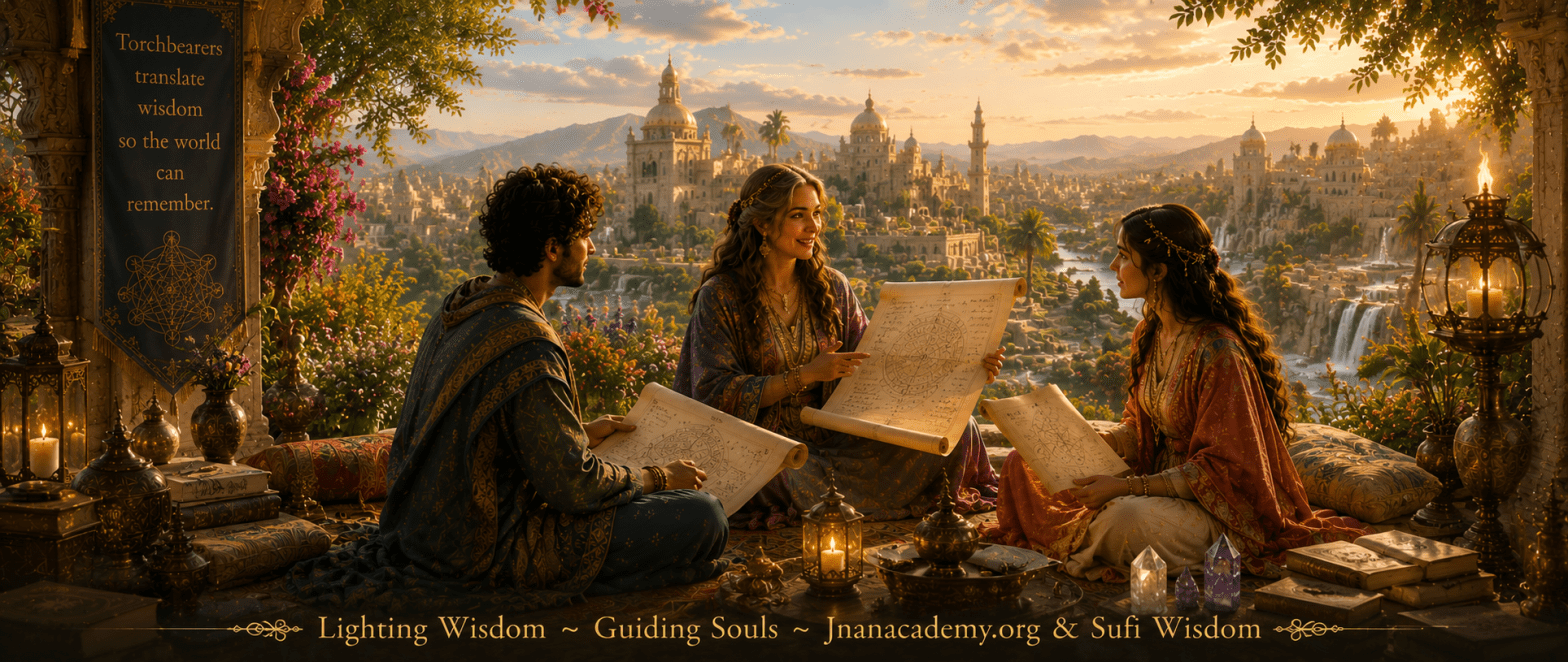
Why a Sufi is less interested in collecting answers — and more interested in discovering them.

Written by Rozelinde
A life of learning across people, cultures, systems, and spirituality — mapping the hidden architecture behind how people suffer, connect, lead, compete, heal, and drive cultural change
The way I would describe a Sufi teacher is that they are the lived experience guide among spiritual teachers — the explorer, the support-group facilitator, the person who has walked the road themselves before guiding others. Of course to be fully transparent: there are many Sufi lineages I am not deeply familiar with. What I share here is not a universal definition of Sufism, but my personal understanding shaped by my Sufi-shamanic teacher and my own path. It is not an official definition, nor is it a universally agreed-upon viewpoint. It is simply the lens through which I have come to understand its beauty.
🌿 “First Rule: Leave Your Certainty at the Door.”
Sufism does not begin with doctrine.
The reason I describe it this way is because this is the approach that I was introduced to. Sufism does not begin with rigid black-and-white theories or with the assumption that all truth has already been discovered. Instead, it begins with a beautiful invitation: let go of what you think you know, stay radically curious, and discover what Life itself is trying to teach you today. Every experience becomes a classroom. Every challenge becomes a laboratory. Every encounter becomes another opportunity to uncover wisdom that has not yet been fully seen.
🧭 “Maps Are Helpful. Reality Is Better.”
That is why I call it the path of the lived experience guide.
Not in the least does this dismiss the ancient schools of wisdom. They contain profound insights that have guided humanity for centuries. It is simply that this particular way of teaching begins by letting go of preconceived ideas and fixed frameworks. It still studies those traditions deeply, but it continually asks: How does this reveal itself in lived experience? Does it still hold true? How can we translate it into a language that genuinely helps people today?
🎒 “The Student Backpack Never Comes Off.”
This does not make Sufism better than any other spiritual tradition, nor does it place Sufis below anyone else.
Quite the opposite. It is simply one of the pillars around which this path naturally revolves. Humility remains central. A sincere Mystic Teacher is always a student first.
🔬 “Great… But Does It Actually Work?”
My own Sufi-shamanic teacher was very clear about one thing:
Whatever you discover must first become deeply grounded before you choose to teach it. If you notice a synchronicity, receive a profound intuition, recognise a pattern in someone’s life, or discover a beautiful spiritual insight, you do not immediately proclaim it as truth. First come years of observation. Years of testing. Years of asking yourself difficult questions.
“Am I really seeing what I think I’m seeing?”
“Is this intuition accurate?”
“Does this insight genuinely help people?”
“Can it stand the test of real life?”
🧪 “Please Don’t Publish Your First Spiritual Epiphany.”
Only after wisdom has survived reality for many years does it become something worthy of teaching.
Of course, a student is free to share personal insights, experiences, and discoveries. But they share them for what they are: working theories, lived experiments, field notes from consciousness, and invitations to explore together—not final verdicts about reality.
An observer does not say, “This is the Truth.” More often, they smile and say, “This is what life has been teaching me lately… let’s see where it leads.” 😊
🪞 “Your Blind Spots Are Smarter Than You Think.”
To me, this creates an incredibly ethical foundation.
Spirituality becomes less about collecting impressive ideas and more about developing an honest character. A teacher must be willing to admit when they do not know. They must continually refine their perception. They must remain teachable. They must be willing to discover that yesterday’s certainty can become tomorrow’s deeper understanding.
🚪 “The First Gate Isn’t Faith. It’s Teachability.”
A good spiritual seeker begins with strong ethical foundations:
Otherwise, the mind quickly convinces us that we already know all the answers. A good mentor is honest enough to tell us when we are not being honest with ourselves. We all need that mirror.
“Your Ego Has Entered the Chat…”
💡 “The Universe Rarely Shouts. It Usually Whispers.”
For example, whenever life is not flowing, whenever we become deeply triggered, defensive, hurt, or frustrated, life is not trying to punish us.
It is quietly whispering:
“There is still Light here.”
“There is still a perspective you have not yet seen.”
“There is still wisdom waiting to unfold inside you.”
🧱 🚧 “Congratulations! You Just Walked Into Another Wall.”
That is how deeper wisdom is discovered.
By honestly looking at the places where we keep walking into walls, meeting irritation, disappointment, resistance, and obstacles. Those moments become doorways to greater understanding—if we are willing to be honest with ourselves.
“Every Wall Is Secretly a Teacher in Disguise.”
🌍 “Life Is the Biggest Spiritual University.”
The greatest teachers are often life itself.
Life teaches through beautiful moments, but also through making mistakes, experiencing heartbreak, encountering uncertainty, losing certainty, rebuilding confidence, discovering blind spots, celebrating breakthroughs, and meeting hundreds of people who each illuminate a different corner of reality.
Every wobble carries information.
Every obstacle carries an invitation.
Every season has something it wants to teach.
📚 “Borrow Every Lamp. Worship None.”
At the same time, this path also learns from many different spiritual traditions.
You are not invited to believe something simply because an important teacher said it. You are invited to explore it. Question it. Live it. Experiment with it. Challenge it. Refine it. Then ask one simple question:
Does this consistently help people become wiser, freer, kinder, more grounded, and more capable of creating beautiful lives?
To me, that is what authentic spirituality looks like.
🔥 Congratulations…#2! You No Longer Fit the Box
One idea that naturally grew from my own journey is something I call the Torchbearer.
In shamanic traditions, there are different reasons why people feel called to become healers. One of those is having a mind that naturally experiences life a little differently from most people— not so conventional that it only sees the obvious, however still grounded enough to think clearly and function well in everyday life.
This is where the idea of the Torchbearer comes in. The Torchbearer is someone who does not quite fit inside the existing cultural map.
Not because they are superior. Not because they are rebellious for the sake of rebellion. But because they do not fit comfortably into conventional expectations. They are simply unable to realise their deepest potential through the standard path because of their unique soul nature. Very often, Torchbearers spend years feeling different.
And because of this dynamic, a natural chain reaction unfolds — spiritually, psychologically, biologically, and socially. It works every single time — and I still find it fascinating how remarkably precise this dynamic is. Time and time again, the same process leads to the same result with remarkable consistency. Since they do not quite fit the mould, their soul keeps sensing that there is another possibility waiting to be discovered.
They are not trying to be difficult.
Something inside simply keeps whispering:
“There must be another way.”
That quiet longing becomes a blessing.
It becomes their life mission.
- “Learn from every tradition, become attached to none, keep discovering.”
Because while many people naturally continue walking the familiar road, the Torchbearer feels called to explore the forest beside it.
- They search.
- They question.
- They experiment.
- They fail.
- They discover.
- They return.
🕯️ Holding a Lantern While Everyone Else Is Looking for a Light Switch 😄: the Ones Who Accidentally Walk Into Tomorrow.
And eventually, they bring back a lantern. Not because they wanted attention. But because they found a part of the path that others had not yet seen.
That is why I call them Torchbearers. They illuminate what society has temporarily forgotten. They help us rediscover possibilities that have always lived quietly inside the human heart.
These are not strange ideas. Not fashionable ideas. These are ancient truths that somehow became hidden beneath noise, fear, certainty, routine, and habit. In that sense, every true Torchbearer is simply reminding us of something we already knew before we forgot.
People who do fit the existing culture are certainly not “less than.” Often, the current culture simply fits their nature a little better—and that is a beautiful thing. The message is not that one group is better than another. The message is simply that society can continue to evolve. There is still room for growth, greater wisdom, more compassion, and better ways of living together. We are all equal in the eyes of the soul. Each soul simply carries a different role in society, and every role is indispensable.
In this way, Torchbearers accidentally bring back treasures—new perspectives, forgotten wisdom, and fresh approaches that society has been quietly searching for all along.
Every culture naturally develops strengths, but also blind spots. Certain ways of thinking become so familiar that people stop questioning them. Other possibilities quietly fade into the background and are gradually forgotten.
The person who does not quite fit the existing path is almost forced to search for different answers. In doing so, they accidentally discover what the collective heart has been longing for all along—but no longer knew how to ask for.
Torchbearers carry lanterns—but they also clean the glass. ✨
Seeing new possibilities is only half the work. The other half is continually polishing our own perception so that we don’t mistake imagination for wisdom.
And that brings us right back to where we began.
Torchbearers discover these breakthroughs not because they are smarter than everyone else, but because they remain open. They are willing to question old assumptions, explore unfamiliar paths, and welcome perspectives that initially feel uncomfortable or unexpected.
When we rigidly hold on to the way we have always thought, we stop seeing new possibilities. We unintentionally close the very door through which wisdom wants to enter.
Perhaps that is why so many of today’s challenges—burnout, chronic stress, loneliness, anxiety, conflict, and even war—continue to repeat themselves. If we genuinely want different outcomes, we must first become willing to think differently.
That is exactly what the soul longs for: not more information, but a greater openness to discover a wiser way of being.
If we genuinely want different outcomes, we must first become willing to think differently.
🌿 “Back to step One: Become Gloriously Wrong.”
A good student—and a good teacher—continually questions themselves.
Before we can become a wise guide, we first need to become an excellent student. We need the humility to learn, to receive feedback, and to notice when our own thinking has become rigid or stubborn. That is one of the first gates of real spiritual development. First we need to be willing to learn and be teachable. On the other side of that gate, we rediscover a much deeper certainty—one rooted in surrender, experience, and trust rather than opinion, illusion or overcompensation.
Yes, ethical mystics also need certainty. Their students need someone who can stand with confidence, clarity, and faith. But lasting certainty is not built by pretending we already know everything. It is reached by first walking through the gate of teachability—questioning ourselves, receiving feedback, testing our insights in real life, and remaining humble enough to keep learning. That is the kind of certainty people can truly trust.
Of course, there is also the opposite pitfall: insecurity, endless self-doubt, and never daring to stand for anything. But we are not there yet. First things first. Before we can build genuine confidence, we first need to develop the willingness to learn and to courageously look into our own mirror. 🪞
Confidence and certainty certainly have their place, but they become far more reliable once we understand how our mind and consciousness actually work.
Life is teaching us every moment, but only if we are willing to listen and learn how to decode its language. That is why spirituality no longer needs to hide in a cave or on a deserted island.
🛩️ “Nobody Gave Us the Instruction Manual.”
And this insight lands us beautifully into another important aspect of Sufism: Spirituality wants to be understood by the people of today, not only the people of yesterday.
Spirituality is not about escaping the world—it is about understanding how our consciousness functions. It is learning to operate the cockpit of our own being. If nobody teaches us how to fly this extraordinary vehicle, it is only natural that we create conflict, fear, poverty, emotional suffering, and division. It is like giving humanity the world’s most advanced aircraft without ever teaching anyone how to fly it.
A Sufi therefore keeps asking: “How can I translate timeless wisdom into a language that helps modern people actually live it?” Our collective consciousness has evolved, and the way we communicate timeless wisdom can evolve as well. The essence does not need to change. Ancient truths that still work can remain exactly as they are, while the language becomes modern, practical, scientifically curious, and immediately applicable to everyday life.
Every person we meet, every face we encounter, and every experience we live through has something to teach us. Each one can reveal a little more wisdom, a little more Light, a little more abundance, and a little more trust. Slowly, we begin to recognise that we are continuously being guided, supported, and cared for by something far greater than ourselves.
🌍 “The Spirituality That Pays the Bills Too.”
To me, spirituality is profoundly practical.
We can be deeply spiritual and deeply modern at the same time. We can build ecological communities, create thriving businesses, become scientists, artists, entrepreneurs, therapists, parents, or teachers. We can earn millions and use those resources to strengthen society, or live a simple and quiet life close to nature. Both paths are equally sacred. Spirituality is not defined by your lifestyle; it is defined by your relationship with life. Do we blame the world for our suffering, or do we allow life to reveal the wisdom and Light hidden within every experience?
That is why I call this the path of the lived experience guide. A Sufi (in my humble understanding and deep respect for the ancient teachings) learns from different spiritual traditions, but equally from life itself, because life is teaching us every single day, every single minute. The universe is continuously speaking to us. The real question is whether we know how to recognise its language.
🔥 “When All Rivers Meet the Same Ocean.”
Over time, something beautiful begins to happen.
You start recognising the same timeless principles appearing across many different spiritual traditions. Rather than seeing contradiction, you begin seeing connection. You discover the wisdom that quietly bridges them all. Not because someone told you it was there, but because you have lived it, tested it, questioned it, and experienced it for yourself.
That, to me, is the heart of Sufism.
To Summarise: 🪄 Mysticism Without the Fog Machine
✨ Spirituality That Actually Works: The Foundations of Ethical Mysticism
Ethical mysticism is the art of becoming deeply spiritual while remaining deeply human. It begins with humility, curiosity, and teachability. Its purpose is not to escape the world, but to understand consciousness so profoundly that we become wiser, freer, more loving, more allowing, and better able to contribute to life.
How Not to Accidentally Become a Terrible Guru – and Become Wise Without Becoming Weird.😄
Seven principles that help us become wiser, freer, more grounded, and more deeply human.
1. Life is the real classroom.
A mystic does not only study books or teachers. Every experience is trying to teach you something if you know how to decode its language. Every conversation, disappointment, coincidence, success, and challenge becomes living curriculum. Frustration and conflict are not interruptions of the path—they are the path.
Life is not interrupting your spiritual path—it is your spiritual path.
2. Before wisdom can guide others, it must survive reality.
A beautiful insight is only the beginning. Living it, testing it, and watching it consistently improve people’s lives is what transforms an idea into wisdom. Wisdom becomes trustworthy after years of being tested against real life.
3. Teachability is the first gate of spiritual mastery—it is the wrapping paper around certainty.
Before we can reach genuine certainty, we must first move through flexibility. We must become willing to question ourselves, receive feedback, let go of rigid thinking, and admit that we may not yet see the whole picture. Teachability and certainty are twins—you can never truly have one without the other. The willingness to question yourself is what eventually allows genuine certainty, faith, and inner peace to emerge.
4. Spirituality is learning to fly the cockpit of your own consciousness.
Humanity has been given an extraordinary vehicle, yet almost nobody is taught how to operate it. That is why so many unnecessary struggles exist. Much of our suffering comes from never learning how our own consciousness works. Spirituality is about learning how to navigate the modern, real world brilliantly. The goal is not to leave society, but to understand the cockpit of your own consciousness so you can live wisely within it.
5. A spiritual teacher should be the hardest person to fool.
Not because they doubt everything, but because they patiently test every insight until it has survived real life.
6. Torchbearers do not create stand-alone truths; they translate forgotten wisdom for a new generation.
Their gift is seeing possibilities that society has temporarily overlooked and translating them into something practical for today. They do not reject ancient wisdom; they make it understandable for the modern world.
Their message – the new path they light up – is not only for themselves. They unintentionally mirror the cry of the collective human soul. They bring to the surface what humanity secretly misses, longs for, and yearns to rediscover, but has suppressed for too long beneath conditioning, fear, and routine.
7. Ancient wisdom remains timeless because it can always be translated.
Classical traditions, sacred texts, and ancient wisdom remain profoundly relevant and deeply guiding. Giving them new language and modern frameworks is not a dismissal of old truths. Spiritual teachings exist to help us recognise what life has been trying to teach us all along.
In short:
- Teachability is the first gate of mastery.
- Spirituality is learning to fly the cockpit of consciousness.
- Torchbearers translate forgotten wisdom and longing.
🥈 The Universe Never Invented VIP Souls.
🎭 Different Costumes. Same Light 🧩 Every Piece Matters. Even the Weird-Shaped Ones. 😄
Every role and every path is equally sacred. Every soul has its own unique and indispensable contribution to the evolution of consciousness and humanity. No role, profession, or way of life is greater or lesser than another.
The Source does not compare its children—and neither should we. At the level of the soul, we are profoundly equal.
Conditioning makes us forget our true nature. The work of remembering is the work of coming home—to our Light, our wisdom, our purpose, and to one another. That is the journey I hope to support, one conversation, one insight, and one life at a time.
“My work is an original integrative approach, inspired by Sufi teachings, Kabbalistic wisdom, Ayurveda, shamanic traditions, New Thought, the Abraham (Hicks) Teachings, trauma-aware coaching, and practical emotional transformation.”

